
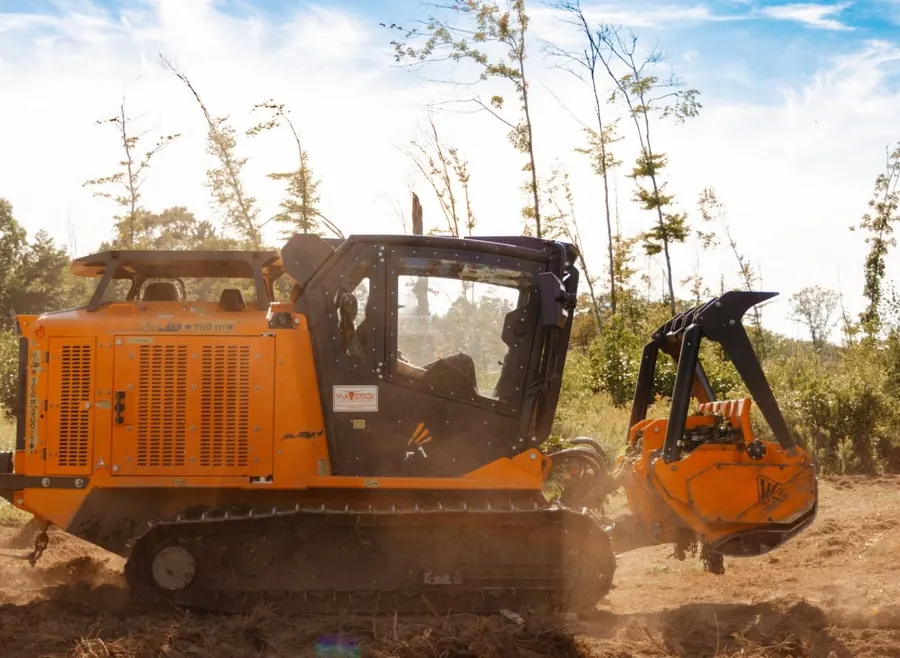
Forestry mulching is clearing land with one tracked machine that cuts brush and small trees and grinds them into mulch where they stand, leaving the chips on the ground. It is the right call when you want overgrowth gone without piles, burning, hauling or torn-up soil, and the wrong call when stumps have to come out or the ground is going to be built on.
How the machine works
A forestry mulcher is a tracked carrier with a spinning drum on the front. The drum is lined with hardened teeth. The operator lowers it onto brush or lays it against a standing stem, and the teeth shred the wood into chips as the machine moves ahead. A sapling is taken from the top down, then the stub is ground off near the dirt. What was a thicket a minute ago is a layer of mulch behind the machine. There is no second machine, no chipper and no truck. Cutting and cleanup happen in the same pass.
What it handles
A mulcher is made for the growth that takes over neglected ground in our area: multiflora rose, autumn olive, bush honeysuckle, buckthorn, briars, grapevine, saplings and small trees. It works in places a tractor and brush hog cannot go, on rough, stumpy or sloped ground, and through stems far too thick for a mower. It can also work selectively. The operator can clear the underbrush and leave the oaks, maples and hickories you want standing. Our brush mulching and overgrowth clearing page shows the kind of ground it opens up.
What is left when we finish
You are left with open ground covered in a layer of wood chips, with the stubs of cut stems ground down close to the soil. The roots stay in the ground and hold it together. The mulch shades the soil, slows the rain and breaks down over time. There are no brush piles to burn and no ruts from trucks. You can walk it, drive a side-by-side over it, and in most cases mow it afterward. What you do not get is bare, graded dirt, and the stumps are not dug out.
The jobs it is made for
Mulching fits any job where the goal is to take back ground, not to move dirt. Think of an overgrown pasture or back field, a hedgerow that has crept into the hay, a fence line or property line you can no longer walk, trails and shooting lanes on hunting ground, the woods edge around a yard, a view to a pond, or a utility or access strip. It is also a good first step on a lot you are thinking of buying or building on, because it lets you see the lay of the land.
When it is the wrong tool
Mulching leaves roots and chips in the ground, and both are trouble under a building. A house pad, a pole barn floor or a driveway needs the stumps dug out and the organic material stripped off, which is excavator and dozer work. It is also not the tool for large timber. Big trees are better felled and handled with an excavator. Very wet ground has to wait, and ground full of rock or old wire is slow and hard on the machine. Jeff will look at your ground and tell you which machine fits.
Forestry mulcher versus brush hog
People often ask if a brush hog would do. A brush hog is a heavy rotary mower pulled behind a tractor. It is fine for tall grass, weeds and whip-thin saplings on ground a tractor can drive over. It stops where the stems get thick, the stumps get close together or the ground gets rough. A forestry mulcher starts there. It grinds woody growth that would stall a mower and leaves fine mulch instead of slashed stems. Once we have mulched a field, a brush hog can usually keep it open.
How a mulching job goes with us
It starts with a call and a walk of the property. Jeff looks at what is growing, how thick it is and how the ground lies, and asks what you want the land to be when he leaves. You point out the trees to keep, the property lines and anything buried or hidden in the brush. Then he recommends the approach and gives a free estimate. On the day, the machine works the area in passes and the ground is left clean. Read more on our forestry mulching page.
Common Questions
Is forestry mulching the same thing as land clearing?
No. Land clearing is the general term for removing trees and brush from ground. Forestry mulching is one way of doing it, where a single machine grinds the growth in place and leaves the chips. Other clearing uses an excavator to pull trees and stumps and stack them. Mulching is faster and gentler on the soil for brush and small trees. Pulling stumps is needed where you will build.
Can a forestry mulcher take down trees, or only brush?
It takes down small trees as well as brush. The machine works a standing stem from the top down and grinds it as it goes. As trunks get bigger the work gets slower, and at some size it makes more sense to drop the tree with an excavator. When Jeff walks your site he will point out which trees the mulcher will take and which should be handled another way.
Does forestry mulching remove the stumps and roots?
No. The mulcher grinds each stem down to a low stub at about ground level and leaves the roots in the soil. That is a benefit on slopes and in fields, because the roots hold the ground. If you need stumps gone for a lawn, they can be ground below the surface afterward. If you are building, they have to be dug out.
What to Do Next
Not sure if mulching fits your ground? Call Jeff at (330) 625-5754 and describe it, or send photos through the form. He will come look and give you a free estimate. We mulch close to home around Cortland and across Ashtabula County.