
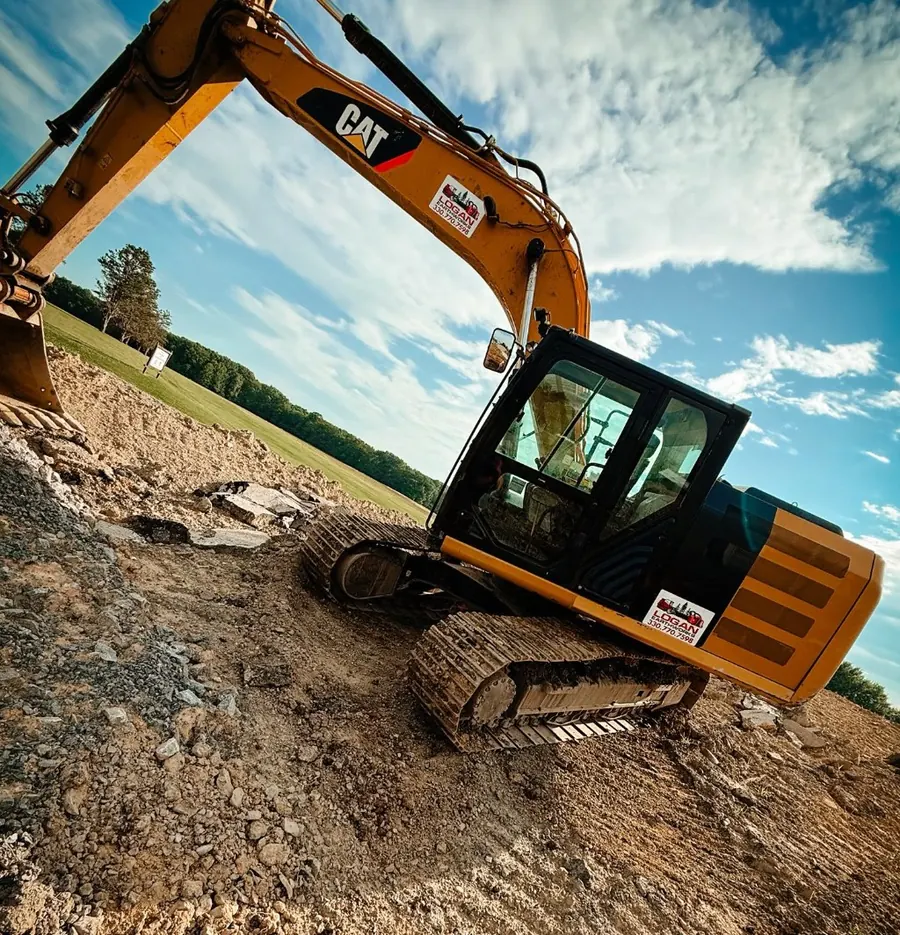
An excavation quote in Ohio is built from how much dirt has to move, what that dirt is made of, where it ends up and how easy the site is to reach and work in. Rock, water, tight access and trucking soil off the site push a price up, and a level, open site where the dirt stays on the property keeps it down; Jeff gives a free estimate after seeing the ground.
How much dirt moves, and how far
Excavation is paid for in machine time, and machine time follows volume. A basement dig moves far more soil than a crawl space or a shallow footer trench. A pond takes out more than both. Distance matters as much as volume. Dirt that is dug and set down beside the hole is handled once. Dirt that has to be carried across a site to build up a low corner is handled again, and each extra move adds hours. The first thing we work out on any job is how many yards move and where each one goes.
What the ground is made of
Topsoil and loose loam dig fast. A lot of ground in northeastern Ohio does not. Glacial clay is dense and sticky, hardpan has to be ripped, and shale or sandstone can sit close under the surface, more so as you head into the hillier country to the south and east. Rock that a bucket cannot break slows a dig sharply. Water does too: a hole that fills from a seep or a high water table has to be worked wet. Nobody can see through sod, so a fair quote says what it assumes about the ground.
Where the spoil goes and where fill comes from
The least costly site is one that balances: what is cut from the high side fills the low side and nothing crosses the property line. When there is more dirt than the site can use, it has to be trucked off, and that means trucks, drivers and a place willing to take it. When there is not enough, clean fill or stone has to be brought in by the load. Either way, trucking can add as much as the digging. Keeping good dirt on site for backfill and final grading saves money later.
Access and room to work
An open lot with a firm way in lets a full-size excavator and a dozer work at full pace. A back yard reached through a side gate, a lot squeezed between houses, a steep bank or a soft field lane all mean smaller machines, more careful moves or extra prep just to get in. Overhead wires limit how high a boom can swing. Trees to be saved, a septic field or a neighbor's fence limit where dirt can be piled. Every one of these adds time, and time is what you pay for.
Depth and how exact it has to be
Rough earthmoving is fast. Precise digging is slower. A foundation has to be dug to the depth and lines your builder stakes out, with a flat, undisturbed bottom for the footers. Utility trenches have to hold the depth and slope the water, sewer or electric line calls for. Deep holes need their sides sloped back so they stay open, and that widens the dig. The tighter the tolerance and the deeper the cut, the more hours per yard of dirt.
Buried lines and the checks before digging
Buried utilities shape both the price and the schedule. Ohio law has excavators contact OHIO811 at least two working days before digging, not counting the day of the notice, so the lines can be marked. Check OHIO811 for the details. Digging close to a marked line means slowing down and exposing it by hand. Private lines are another matter. A line to a barn, a yard light, an old field tile or a septic line will not be marked by the utility companies, so tell us where yours run. For more on rules that touch pond work, see our pond digging page.
Weather, timing and how the job is quoted
Clay that is fine in August can be unworkable in April. Wet ground slows digging, ruts the site and makes backfill hard to pack, so the season can change how long a job takes. Excavation is quoted by the hour, by the day or as a fixed price for a defined job. Hourly work suits jobs with unknowns. A fixed price suits a clear scope, like a foundation dig to a set of plans. Ask which one you are getting and what happens if rock or water turns up.
Common Questions
Is excavation priced by the hour, by the cubic yard or by the job?
All three are used. Small or open-ended work is often hourly. Large earthmoving may be figured by the yard. A defined job, like a foundation dig to a builder's stakes or a trench of a known length, is usually a fixed price. What matters is that the quote states which it is, what it includes and how surprises such as rock or water are handled.
Why are two excavation quotes for the same foundation dig so far apart?
They are usually pricing different jobs. One may include hauling extra dirt away, backfill after the walls are up and rough grading. The other may cover the hole only. One may have allowed for rock or water and the other not. Line the quotes up item by item: the dig, the spoil, the backfill, the grading and the unknowns. The gap normally explains itself.
Does hitting rock or shale change an excavation price in Ohio?
It can, because rock takes far longer to dig than soil. Soft, layered shale can often be ripped out with a bucket. Hard sandstone or ledge may need a different tool or a change of plan. A straight quote says up front what it assumes about the ground and what the rate is if rock shows up, so you are not surprised halfway through the dig.
Getting a Real Number for Your Job
For a price on a dig, call Jeff at (330) 625-5754 with the plans or just a description of what you need. He will look at the site and give you a free estimate. Learn more about our excavation services, or see the pages for Warren and Youngstown.
See our excavation service or call (330) 625-5754.