
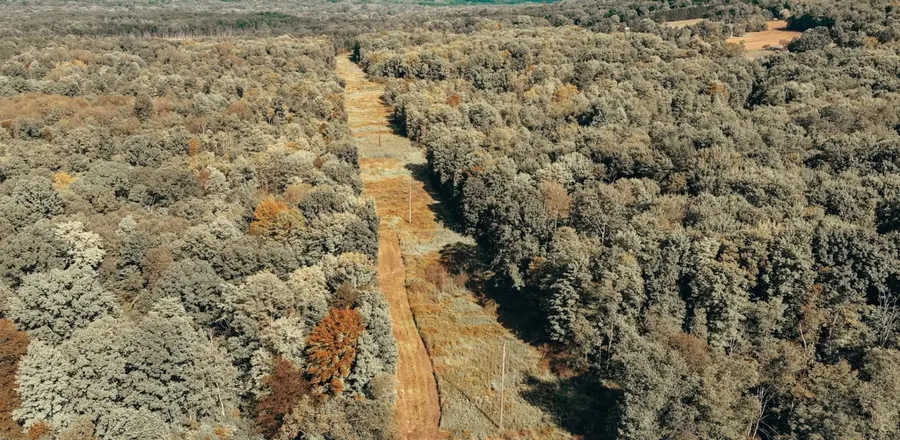
There is no single figure. As a general industry range, not a number for our machine, a forestry mulcher may finish well under an acre in a day in heavy growth or cover several acres in light brush. Light brush and saplings on dry, level ground go fast, while thick stands with tree-size stems, steep banks, wet clay or old fence wire can slow the same machine to a fraction of that pace.
Why nobody can give one number
A mulcher does not clear acres. It grinds wood. How much ground that covers in a day depends on how much wood is standing on each acre. You will see daily figures quoted online, and they range widely because they describe different land. A contractor who promises a set number of acres per day without seeing the property is guessing. That is why Jeff looks at your ground before he talks about time. Then he gives you his honest read on how long it should take.
Density and stem size
These two things decide most of it. Picture a field of goldenrod, briars and finger-thick saplings. The machine drives through it at a walking pace and everything behind it is mulch. Now picture a thicket where the stems are as thick as your arm and so close you cannot push between them. Each one has to be worked from the top, ground down and gone over again. The second acre can take many times as long as the first. Scattered larger trees in the mix slow things further, one trunk at a time.
What kind of growth it is
Soft, tangled growth like multiflora rose and briars shreds quickly. Autumn olive, honeysuckle and buckthorn grow as wide clumps with many stems from one base, and each clump takes a few passes. Grapevine is a nuisance: it ties the canopy together, so cut brush hangs in the air and has to be pulled down. Dense hardwood takes more grinding than soft, fast-grown wood. Dead, dry wood shatters and goes fast. Green, stringy wood takes longer. A mixed stand of all of these is normal on old farm ground around here.
The ground under the brush
Level, dry ground lets the operator work in long, straight passes. A steep bank cuts that down, because the machine has to work up and down the slope and reposition often. Wet clay is slower still, and soft enough ground stops work until it dries or freezes. Rock and ledge force the head up off the ground and wear the teeth. Ditches, old foundations and drop-offs hidden in the brush all have to be found and worked around. Ground you can drive a pickup across is ground a mulcher covers quickly.
Obstacles and trees you want kept
Taking everything is the fastest way to clear. Selective work is slower. If you want the brush gone but the oaks and maples left, the operator spends time steering around each keeper and cleaning up close to the trunk without scarring it. Buildings, fences that are staying, wellheads, propane tanks and property lines all need care. Old fence wire is the worst time thief: it wraps the drum and has to be cut out by hand. Long, straight jobs like right-of-way and utility corridor clearing tend to move quickly.
How fine the finish is
One fast pass knocks everything down and leaves coarse pieces. That is all a back field or a first cut on hunting land may need. Going back over the same ground grinds the material finer, cuts the stubs closer and leaves it ready to mow or seed. That second pass adds real time. A finish near the house takes longer per acre than a rough opening at the back of the farm. Our brush mulching page shows both kinds of result.
So how long does one acre take?
On an acre of light brush and small saplings, with dry ground and nothing hidden in it, the mulching is commonly a matter of hours. On an acre of thick, mature growth with trees mixed in, it can fill a full day and sometimes run past it. Those are general figures for this kind of machine, and most overgrown ground falls somewhere between. The only way to place yours on that scale is to walk it. Jeff will give you his read on the time involved, and that is the basis of his estimate for forestry mulching.
Common Questions
How long does it take to forestry mulch 1 acre of overgrown field?
It depends on what has grown up in it. An acre of weeds, briars and thin saplings on dry, level ground takes hours. An acre choked with thick shrubs, vines and small trees can take a full day or more. Slope, wet soil, rock and buried wire add time. Jeff will look at your field and tell you how long he expects it to take.
How many acres can a forestry mulcher clear per day in thick autumn olive?
Fewer than in open brush, and the real number comes from seeing the stand. Autumn olive grows in wide, many-stemmed clumps that take several passes each, and old stands often have grapevine and fence wire through them. Young, scattered olive goes quickly. A solid wall of it is some of the slowest brush we cut.
Does a bigger forestry mulcher always clear more ground in a day?
Not always. A larger machine grinds heavy stems faster, but it needs room. Between trees you want kept, on tight lots, along fences or on soft ground, a more compact tracked machine can work where a big one cannot turn or would sink. The right match of machine to site matters more than size alone.
What to Do Next
Want to know how long your ground would take? Call Jeff at (330) 625-5754 or send the form with a few photos. He will walk it and give you a free estimate. We take jobs around Akron and across Portage County.