
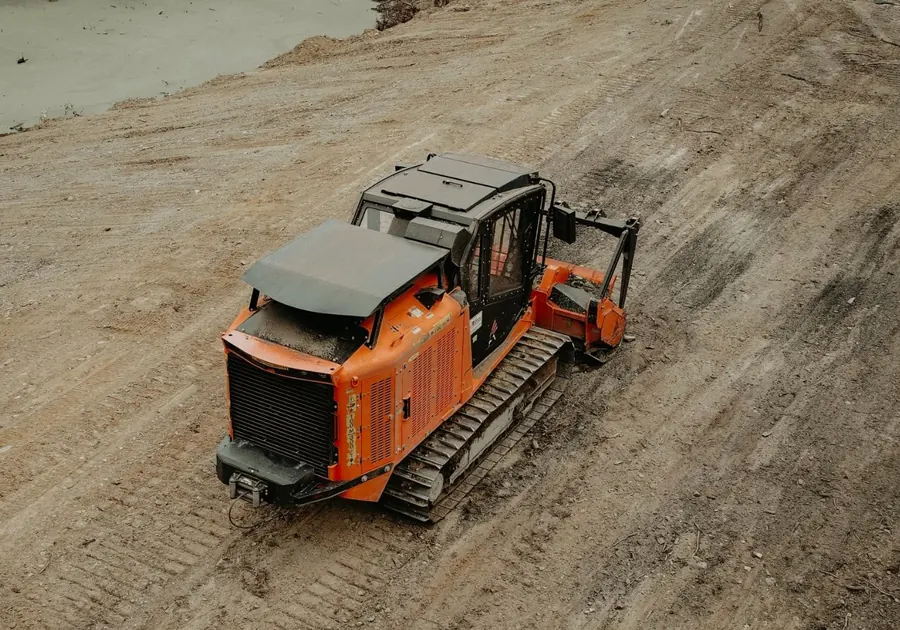
Choose forestry mulching when you want brush and small trees gone but the soil left in place: fields, fence lines, trails, woods edges and views. Choose bulldozing or excavator clearing when the stumps and roots have to come out, which means anywhere you will build, pour a slab, lay a driveway or regrade the ground.
What each method does
A forestry mulcher grinds standing brush and small trees into chips and leaves them on the ground. It cuts at the surface and does not dig. A bulldozer pushes growth over and scrapes it, roots and all, into piles, taking a layer of soil with it. An excavator does a cleaner version of the same thing, lifting trees and stumps out one at a time. So the real choice is not between two machines. It is between clearing the top and leaving the ground alone, or clearing down into the ground.
What happens to the soil
This is the biggest difference. Mulching leaves the topsoil where it is, with the roots still holding it and a blanket of chips over it. Rain soaks in instead of running off. Dozing strips that protection. The topsoil is mixed, pushed into the piles or scraped away, and what is left is bare, loosened dirt. On a slope, bare dirt washes in the first hard storm, and in our clay it turns to mud that tracks everywhere. If you doze, plan to grade and seed quickly. If you do not need the dirt disturbed, do not disturb it.
What happens to the brush
After mulching there is nothing to get rid of. After dozing you have piles: trees, stumps, roots and dirt pushed together. Those piles have to be burned, buried, hauled or left to rot at the edge of the lot. Burning is tightly regulated in Ohio, and brush cleared for a building site falls under the strictest part of the rule, as our guide to Ohio open burning rules explains. Dirt-filled piles burn poorly anyway. Dealing with piles is often what makes dozing cost more than the first quote suggested.
Stumps and roots
Here dozing and excavating win. A mulcher leaves low stubs and every root. That is fine under a pasture and a problem under a building. Wood left in the ground rots and leaves soft spots, so a house pad, a pole barn floor or a driveway base needs the stumps dug out and the organic soil stripped. That is the first step in building a pad for a home, garage or pole barn. No amount of mulching makes ground ready to build on. It only makes it easier to see what you have.
Big trees and speed
Through brush and small trees, a mulcher is hard to beat for speed, because it never stops to stack or load. As trees get larger the balance shifts. A mulcher has to chew a big trunk down bit by bit, while an excavator can lay it over and set it aside quickly. On a lot with real timber on it, the faster and less costly plan is often to take the big stems with the excavator and let the mulcher clean up everything else.
What drives the cost of each
Mulching cost follows machine time: how thick the growth is, how big the stems are, and how rough or wet the ground is. Dozing and excavating cost follows machine time too, plus everything that comes after: handling the piles, filling stump holes, regrading torn-up ground and getting it seeded before it washes. Compare the full job, not the first day. For open land that just needs to be usable again, mulching is usually the smaller bill. For a building site, the dozer work has to be done regardless.
Often the answer is both
Many properties need each method in a different spot. On a new home site we will often dig out the house footprint and the drive with the excavator, then mulch the rest of the lot so it is open and walkable without being stripped bare. The owner gets a buildable pad and a yard that is not a mud field. We set that up as part of lot clearing for new homes and builds, so each part of the lot gets only the work it needs.
Common Questions
Is forestry mulching or bulldozing better for land I plan to build on?
For the building footprint itself you need stumps and roots out, so that part is excavator or dozer work. Mulching is useful around it: opening the rest of the lot so you can see the ground, lay out the house and drive, and keep the soil covered. Most house lots end up with some of each.
Does bulldozing cause more erosion than forestry mulching?
Yes. Dozing removes the roots, the topsoil cover and the plant litter that hold soil in place, and leaves loose, bare dirt. Mulching leaves the roots in the ground and a layer of chips on top, so rain soaks in. On a slope or near a creek or pond the difference is large. Dozed ground should be graded and seeded as soon as possible.
Can you mulch a property first and bring in a dozer later?
Yes, and it is often a smart order. Mulching first opens the ground so you, a surveyor or a builder can see slopes, wet spots and property lines before deciding where anything goes. Later, only the area that will be built on needs to be stripped and have its stumps dug out. The rest stays covered and stable.
What to Do Next
Tell Jeff what you want the land to be and he will tell you which method it needs. Call (330) 625-5754 for a free estimate after a site visit. Learn more about forestry mulching, or see our pages for Youngstown and Columbiana County.