
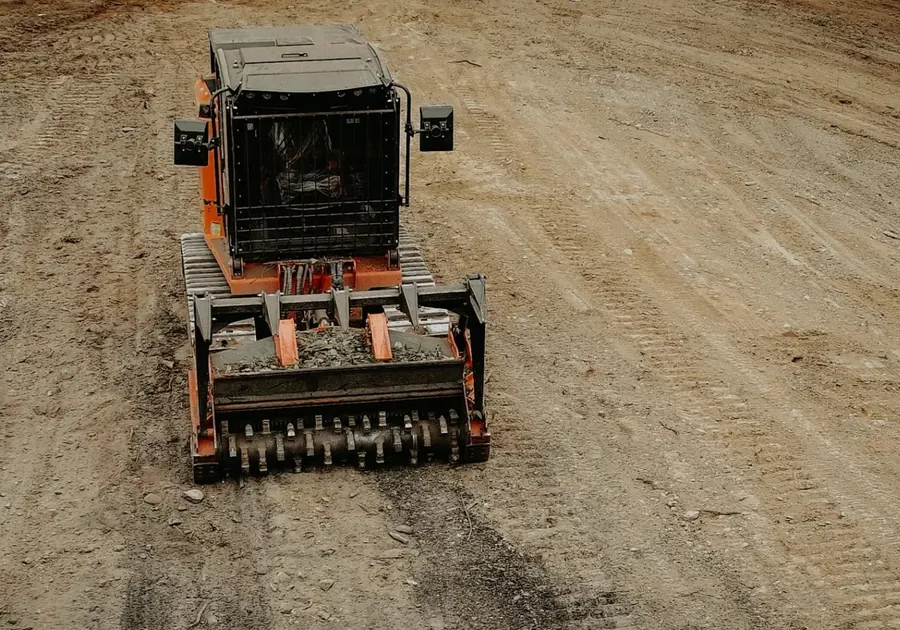
Forestry mulching is worth it when you want brush and small trees gone without piles, burning or torn-up soil, and you can live with the roots and low stumps staying in the ground. Its real downsides are regrowth from those roots, a mulch layer that takes time to break down, slow going on big trees, and the fact that it does not make ground ready to build on.
Downside one: the roots and stumps stay
A mulcher cuts at ground level. It does not dig. Every stem it grinds leaves a root system in the soil and a low stub at the surface. On a slope that is a good thing, because those roots hold the bank together. In a lawn it is a nuisance, and under a building it is a problem. If you need smooth ground to finish-mow, the larger stubs have to be ground below the surface afterward. If you need to pour concrete or lay a drive, the stumps must be dug out with an excavator.
Downside two: brush comes back
Mulching does not kill most of what it cuts. Multiflora rose, autumn olive, honeysuckle and many hardwood saplings resprout from the roots, and seed in the soil wakes up once sunlight hits it. If nothing is done after the machine leaves, the ground will be brushy again in a few seasons. The fix is simple: mow the regrowth while it is soft, or have the stumps and sprouts treated. We lay out the follow-up on our invasive brush removal page.
Downside three: the mulch itself
Heavy growth makes a lot of mulch. Where the brush was thick, the chips can lie deep, and deep mulch is slow to rot and hard to seed into. Grass seed will not root in a thick mat of wood, and rotting chips tie up nitrogen at the soil surface for a while. Coarse pieces can be rough to walk on at first. For woods, trails and hunting ground none of that matters. For a lawn or a hay field, plan on thinning or working in the heavy spots before you plant.
Downside four: it is slow on big trees
A mulcher is built for brush and small trees. It can chew through larger trunks, but it does it a bite at a time, and that time is on your bill. Past a certain size it is quicker to drop the tree with an excavator and deal with the log another way. If your ground is mostly mature timber, mulching alone is the wrong plan. A mix works well: the excavator takes the big stems and the mulcher cleans up the tops and the understory.
Downside five: it does not prepare a building site
Some landowners expect a mulched lot to be ready for a foundation. It is not. The organic layer, the roots and the chips all have to come off before a pad or a driveway base goes down, because anything that rots will settle. Mulching is still useful ahead of a build. It opens the lot so you can see slopes and wet spots and decide where the house goes. Just do not count it as site prep.
Rock, wire and flying debris
A mulching head throws chips and the odd stone a long way, so people, pets and vehicles need to stay well back while it runs. Rock and scrap metal in the brush dull or break teeth and slow the job. Old woven wire and barbed wire wrap the drum. This is why Jeff asks about old fence rows, dump piles and stone before he starts. Along a line where wire may still be buried in the trees, such as an old fence line or property line, he goes slower on purpose.
Where it earns its keep
Set those limits against what you get. One machine, one pass, and overgrown ground is open by the time the machine is loaded back up. No brush piles, so no burning rules to deal with and nothing to haul. The soil stays put, covered and held by roots, which matters on slopes and near water. The machine reaches rough, stumpy ground a tractor cannot mow. For fields, fence rows, trails, woods edges, pond banks and overgrown lots, it is usually the fastest and least disruptive way to take the land back. That is the work our forestry mulching service is for.
Common Questions
What are the downsides of forestry mulching that people find out too late?
Three surprise people most. Brush resprouts from the roots, so the ground needs mowing or treatment the next season. Stumps are cut low, not removed, so a finish mower can find them. And heavy mulch has to be thinned before grass seed will take. None of these is a reason to skip mulching, but they should be part of the plan.
Is forestry mulching worth it for just one or two acres?
Often yes. Small overgrown lots are where piling and burning are hardest and where a neighbor is closest. A mulcher can often clear ground like that in a short visit, and it leaves nothing to get rid of. Moving the machine in is a larger share of a small job, so the per-acre figure runs higher than on big acreage. Jeff will give you a free estimate.
Is forestry mulching bad for the soil?
No, it is one of the gentler ways to clear. The topsoil is not stripped or pushed into piles, the roots stay to hold the ground, and the chips cover it against rain and sun. As the mulch rots it adds organic matter. The one drawback is short term: a thick layer slows grass and ties up some nitrogen until it breaks down.
What to Do Next
If you are weighing mulching against another way of clearing, call Jeff at (330) 625-5754. He will look at the ground, tell you honestly which fits, and give you a free estimate. We take jobs around Canton and across Stark County.