
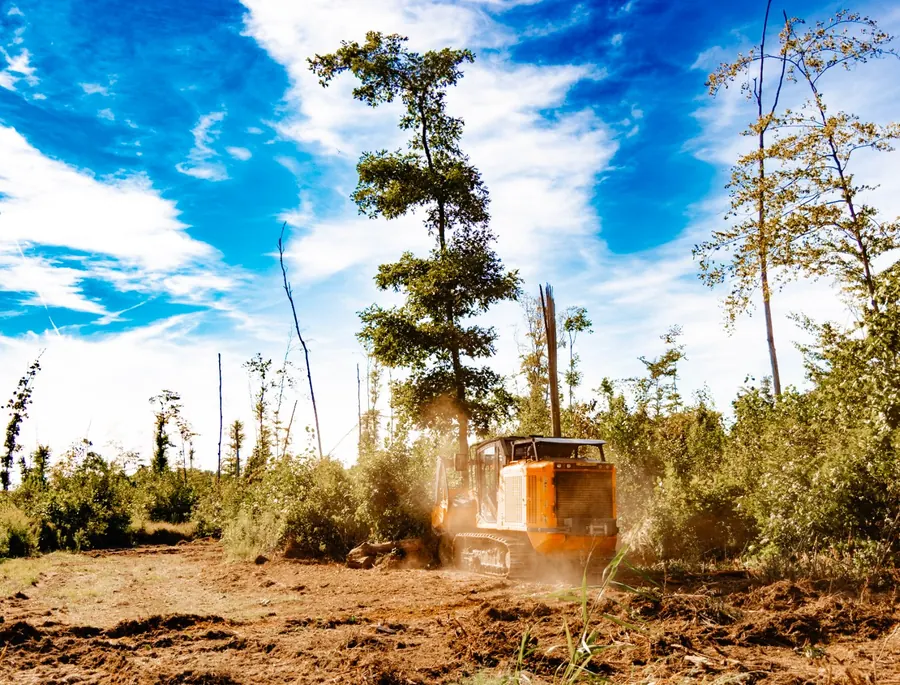
Forestry mulching in Ohio is priced on machine time, so the cost per acre rises and falls with how thick the growth is, how big the stems are, how the ground lies and how clean you want it left. Two acres on the same road can take very different time, so Jeff looks at yours and gives a free estimate.
Why per-acre prices cover such a wide range
Search this question and you will find numbers that are far apart. They can all be honest. An acre is a measure of ground, not of work. One acre might be knee-high briars and thumb-thick saplings that the machine walks through. The next might be a wall of old autumn olive and grapevine with trees mixed in, where every pass is slow. A contractor who quotes one flat rate for both is guessing. The useful question is not what an acre costs. It is how long your acre will take, and that comes from looking at it.
Density and stem size: the two biggest drivers
How much wood is standing on the ground decides most of the price. Light brush and scattered saplings mulch quickly. As stems get thicker and closer together, the machine has to slow down, work each trunk from the top, and go back over the pieces to chew them fine. A field let go for a few seasons is a different job than one let go since the last generation farmed it. When Jeff walks a site he is mostly judging two things: how many stems there are, and how big around the biggest ones are.
What is growing there
Species changes the work. Multiflora rose and briars are tangled but soft, and they go down fast. Autumn olive, bush honeysuckle and buckthorn grow in dense clumps with many stems from one root crown, and those take more passes. Grapevine ties the tops together, so cut brush hangs instead of falling. Hardwood saplings are tougher on the teeth than soft, fast-growing stems. If the job is mostly invasive shrubs, our invasive brush removal page explains how we go at them and what to expect when they try to come back.
Slope, wet ground and rock
A tracked mulcher handles rough ground well, but ground conditions still set the pace. On a steep bank the operator works up and down the slope and covers less in an hour. On saturated clay the tracks cut ruts and the machine can bog, so a wet bottom may have to wait for a dry spell or a freeze. Rock is its own cost: surface stone and ledge are hard on the cutting teeth and force the operator to hold the head higher. Flat, dry, stone-free ground is the least costly ground to mulch.
Hidden junk and old fence
Old farm ground hides things. Woven wire and barbed wire grown into a hedgerow, steel posts, a dump of cans and bedsprings behind the barn, field stone piled along a line: all of it is hard on a mulching head and the teeth that do the cutting. Wire wraps the drum and has to be cut off by hand. If you know where the old fence ran or where the junk pile is, say so at the estimate. Known trouble can be worked around or pulled first. Surprises found by the machine cost time.
How clean you want it left
There are levels of finish. A rough pass knocks everything down and leaves coarse chunks, which is fine for a back field or a first cut on hunting ground. A finish pass grinds the material finer and cuts the stubs closer to the dirt, which you want near a house or anywhere you plan to mow. Selective work costs more per acre than taking everything, because the operator is steering around trees you want to keep. Decide what the ground is for, and you only pay for the finish that use needs. See brush mulching and overgrowth clearing for examples.
Job size, access and travel
Getting a mulcher to your property takes a truck, a trailer and part of a day whether the job is half an acre or twenty. On a small job that fixed cost is spread over little ground, so the per-acre figure runs higher. On larger acreage it shrinks. Access counts as well: a gate too narrow for the machine, a soft lane, or a back lot reached only through a neighbor's field all add time. Work close to our home base in Trumbull County carries less travel than a job at the far edge of the service area.
How to get a number you can trust
Ask whoever quotes you what the price covers: how fine the finish is, whether trees over a certain size are included, what happens if wire or rock turns up, and whether the price is by the acre, by the day or for the whole job. Then compare like with like. Jeff prices forestry mulching after he has seen the ground, and the estimate is free.
Common Questions
What is the average cost per acre for forestry mulching in Ohio?
Published averages for Ohio cover a very wide range, because they blend light field brush with heavy, tree-filled thickets. An average tells you little about your own ground. Density, stem size, slope, wet soil, hidden wire and the finish you want decide the real figure. Jeff walks the property and gives you a free estimate for that piece of ground.
How much do forestry mulchers charge per hour, and is hourly or per-acre pricing fairer?
Contractors quote by the hour, by the day, by the acre or by the job. Hourly and daily rates put the risk of slow going on you. A per-job price puts it on the contractor, who should have looked closely first. Neither is wrong. What matters is knowing which one you have, what finish it includes and what happens if the machine hits wire or rock.
Is forestry mulching less costly than clearing with an excavator and hauling the brush away?
For brush and small trees it usually is, because one machine does the cutting and the cleanup in the same pass. There are no piles to burn, no trucks and no dump fees. It stops being the economical choice when the trees are large, when stumps must come out, or when the ground has to be stripped for a building. Then an excavator is the right tool.
Getting a Real Number for Your Job
To find out what your acreage would cost to mulch, call Jeff at (330) 625-5754 or send the form with the address and a few photos. He will look at the site and give you a free estimate. We mulch close to home around Warren and across Mahoning County.