Right-of-Way & Utility Corridor Clearing
A right-of-way has to be open from one end to the other, to a set width, without damage outside the line. We clear utility corridors, pipeline routes, access roads and easements with a tracked forestry mulcher and excavators.
Right-of-Way Clearing, Start to Finish
A corridor job has a different shape than other clearing. It is long, narrow and usually crosses ground no truck can reach: creek bottoms, side hills, the back of three farms in a row. The width is fixed by an easement, and every foot outside it belongs to someone who is watching. The crew behind you is waiting for the line to open. Brush piles are not welcome, burning often is not allowed, and trucking debris out of the middle of a mile-long strip makes no sense.
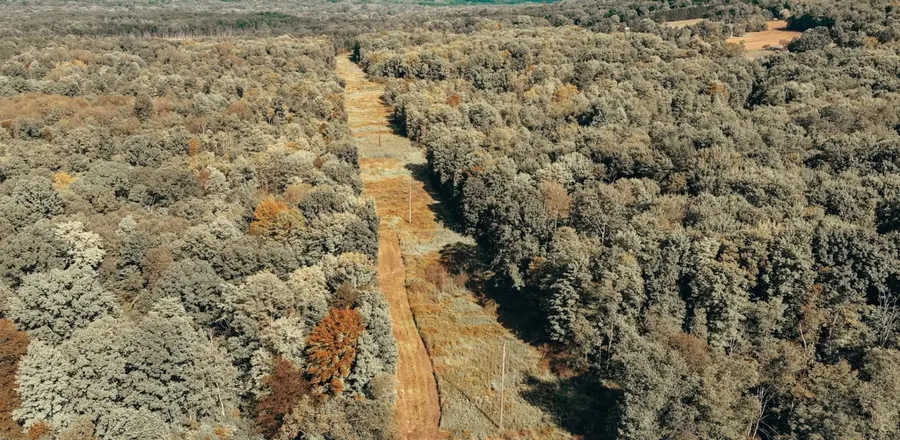
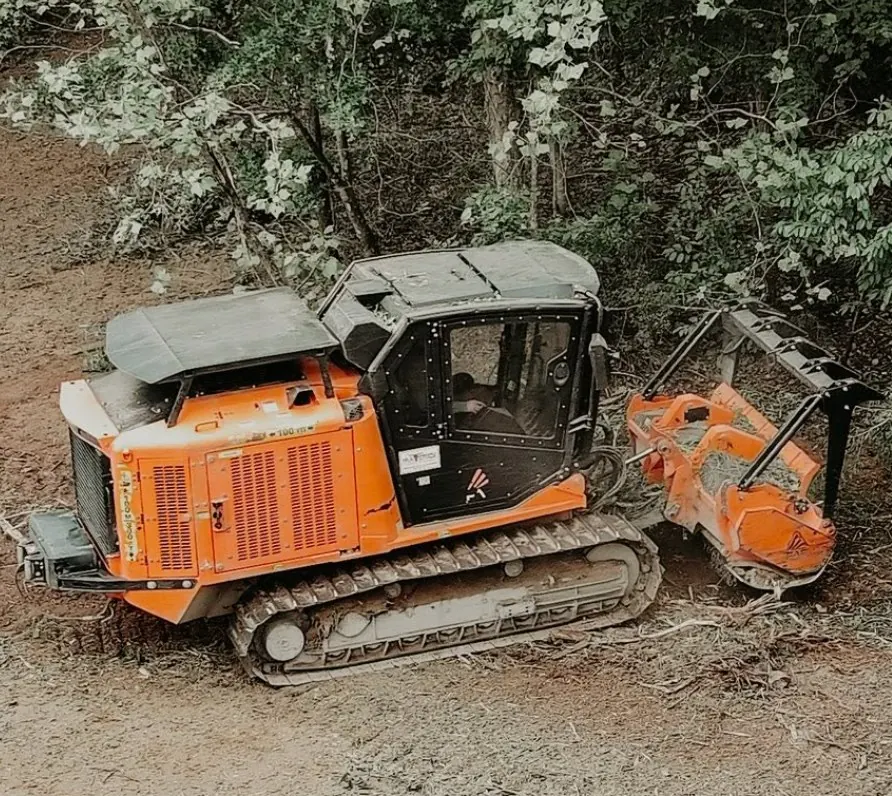
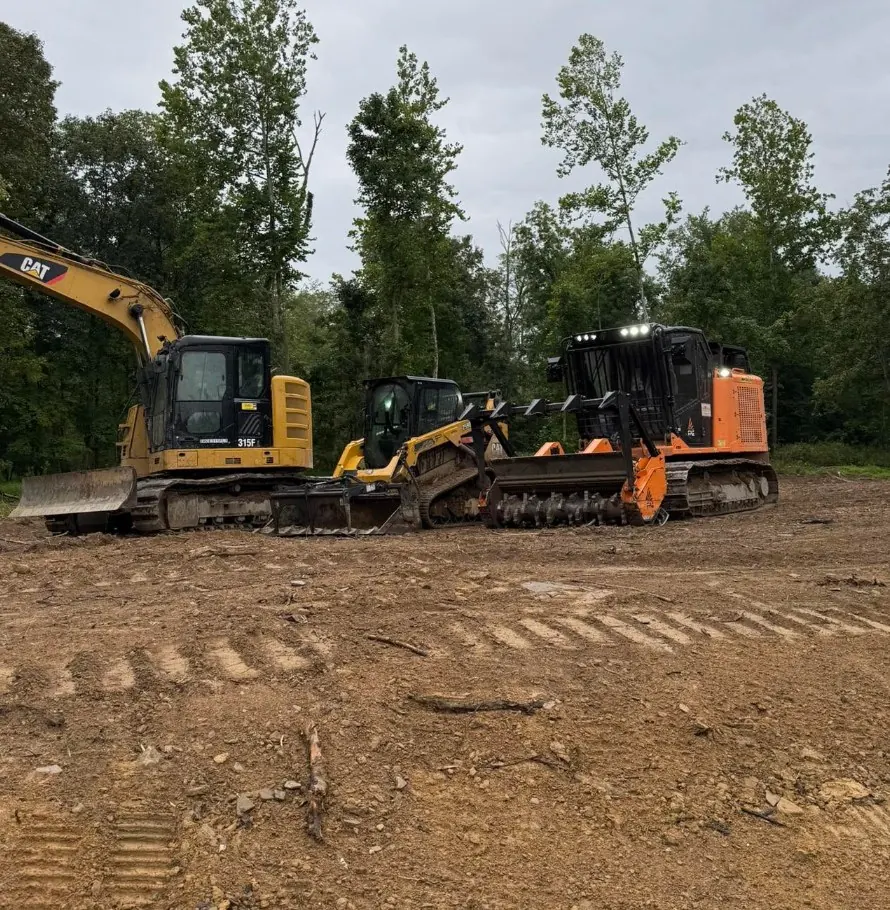
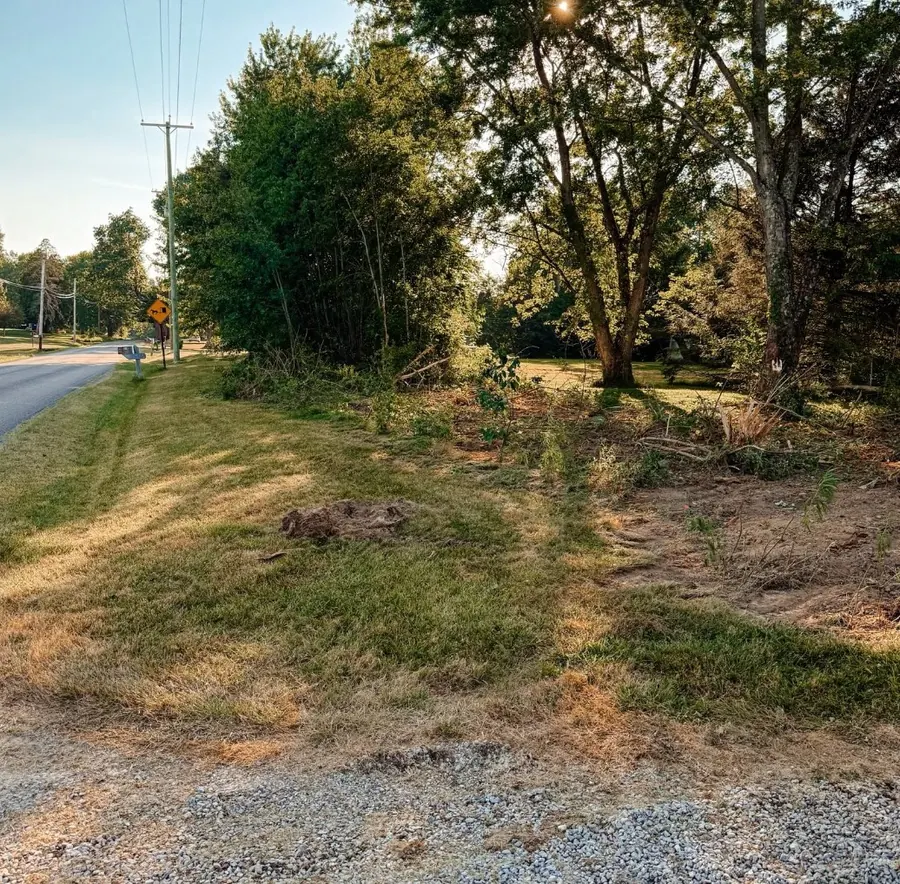
That is why most corridor work is done with a mulcher. Our tracked forestry mulcher cuts and grinds brush and small trees in place and leaves the chips on the ground, where they protect the soil. Nothing has to be hauled, piled or burned. Larger trees come down with the excavator. We work to the stakes or flags your surveyor sets. Ask about drone photos of the finished cut when we look at the job. The photo at the top of this page is a drone view of a cleared strip.
The corridor is left open to the marked width and passable for the crews that follow. We offer this to contractors, developers, municipalities and private owners with an easement to keep open. It is part of our commercial land clearing, built on the same forestry mulching we use on fields and fence rows. Call Jeff at (330) 625-5754 with the length, width and location.
Corridors and Easements We Clear
- Utility corridors and line routes
- Pipeline right-of-way strips and crossings
- Access roads and haul routes
- Drainage and ditch easements
- Private lanes and shared easements
- Regrowth cut back on older corridors
New corridors and old ones grown back in
New work means opening a route for the first time: an electric or water line extension, a pipeline, an access road into a site, a drainage easement. The job is to take everything inside the stakes down to the ground so the trencher, the line crew or the road builder can work. Older corridors need something different. Saplings and brush creep in from both sides until the strip is half its width and nobody can drive it to inspect. One pass with the mulcher resets it. Either way, we want the drawings or a marked route, the required width, and the standard you need for stump height.
Staying inside the line
Easement width is set in the recorded easement or the project drawings, and the edges should be staked or flagged before clearing starts. We cut to the marks and hold that edge. A forestry mulcher is a good match for this because the operator controls exactly where the head goes. Trees outside the line stay. Fences, gates, field tile outlets, wells and anything else the landowner cares about get pointed out on the walk through. On larger projects, ask your engineer about stormwater: Ohio EPA requires construction stormwater permit coverage when a project disturbs one or more acres.
Working near lines, pipes and roads
Corridors exist because something runs through them. Before any digging or stump removal, a locate request has to be placed with the one-call center for that state: Ohio 811, Pennsylvania One Call or West Virginia 811. We sort out who places it when we look at the job. Mulching above ground still gets planned around marker posts, valves, guy wires and pedestals. Tree work close to energized power lines is handled by the utility's own line clearance crews, so bring the utility in before any cutting near live wire. Where a corridor meets a public road, the road's owner decides what happens in its right-of-way. That may be ODOT or PennDOT on a state route, or the county engineer on a county road.
Right-of-Way Clearing, Up Close
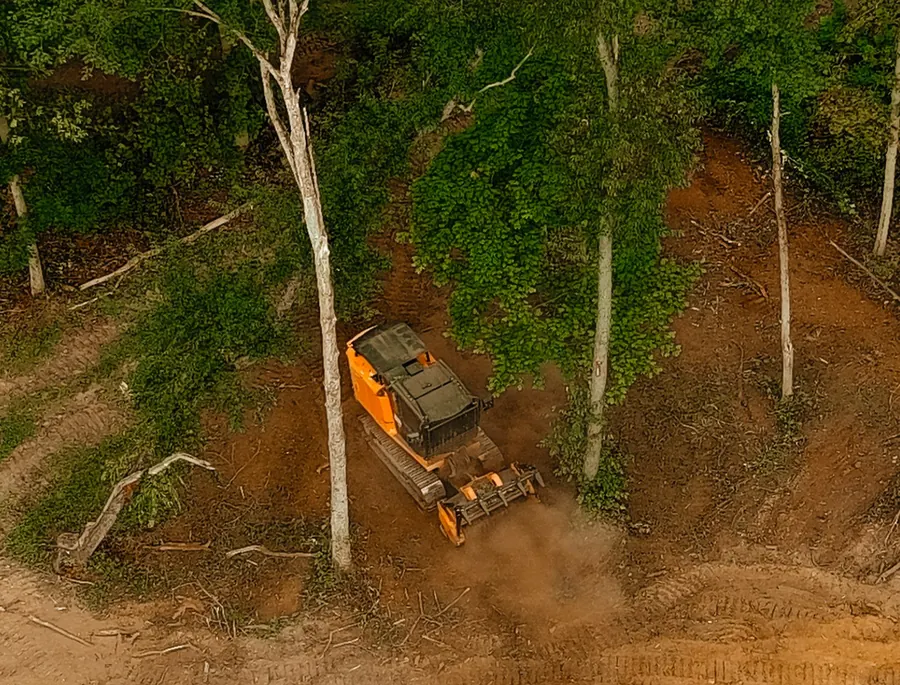
Real photos from Logan Earthworks jobs. See more recent work.
What is right-of-way clearing?
It is removing trees and brush from a strip of land that someone has a legal right to use for a road, a utility line, a pipeline or drainage. The strip has a set width and often runs a long way. The work is done to open a new route or to cut back growth on an old one so crews can build on it, drive it and inspect it.
Do you clear right-of-way for municipalities and utility contractors?
Yes. We work for municipalities, developers, general contractors and utility contractors as well as private landowners. Send the route, the width, the clearing standard and your schedule. If your project has paperwork or site rules a subcontractor has to meet, send those too, and Jeff will go over them with you before the estimate.
How wide does a utility right-of-way get cleared?
As wide as the easement or the project drawings say, and no wider. Widths vary a great deal with the kind of line and who owns it. Have the edges staked or flagged, and we clear to the marks. If you are a landowner unsure what a utility is allowed to clear on your land, the recorded easement is the place to look.
Can a landowner hire you to clear a private lane or an easement to a back lot?
Yes. A lot of corridor work is private: a lane back to a landlocked parcel, a shared drive easement, or a strip for a new water or electric service. We clear it to the width you have the right to use. If the lane then needs a stone base, we also build gravel driveways and private roads.
How is right-of-way clearing priced?
By the job, after Jeff sees the route or good drawings and photos. Length times width gives the area. Then tree size, how thick the brush is, slope, wet crossings and how the machines reach the strip all move the number. So does the standard: mulched in place is the simplest. The estimate is free.
How a Job Runs
Talk It Through
Call or send the form. Tell us where the ground is and what you want it to look like when we leave.
We Look at the Site
Jeff walks it with you: the growth, the slope, the wet spots, the way in and out for the machines.
A Straight Plan
You get a free estimate and a plain recommendation on the approach that fits the ground.
The Work Gets Done
We bring the right machine for the job and do the work the way we said we would.
Clean and Ready
We leave the site cleaned up and ready for the next step, whatever that is for you.
Right-of-Way Clearing Near You
Based in Farmdale, in Trumbull County, Ohio. Pick your town, or call and ask if we cover it.
More services
Commercial Clearing
Site, corridor and industrial property clearing for developers, contractors and municipalities.
DetailsExcavation
Foundation digs, building sites, utility trenches, ponds and general earthmoving.
DetailsSite Prep
Clearing, stripping, rough grading and building pads so your builder can start.
DetailsNeed Right-of-Way Clearing?
Call Jeff or send a few details. Estimates are free, and you get a straight answer on what the job takes.