
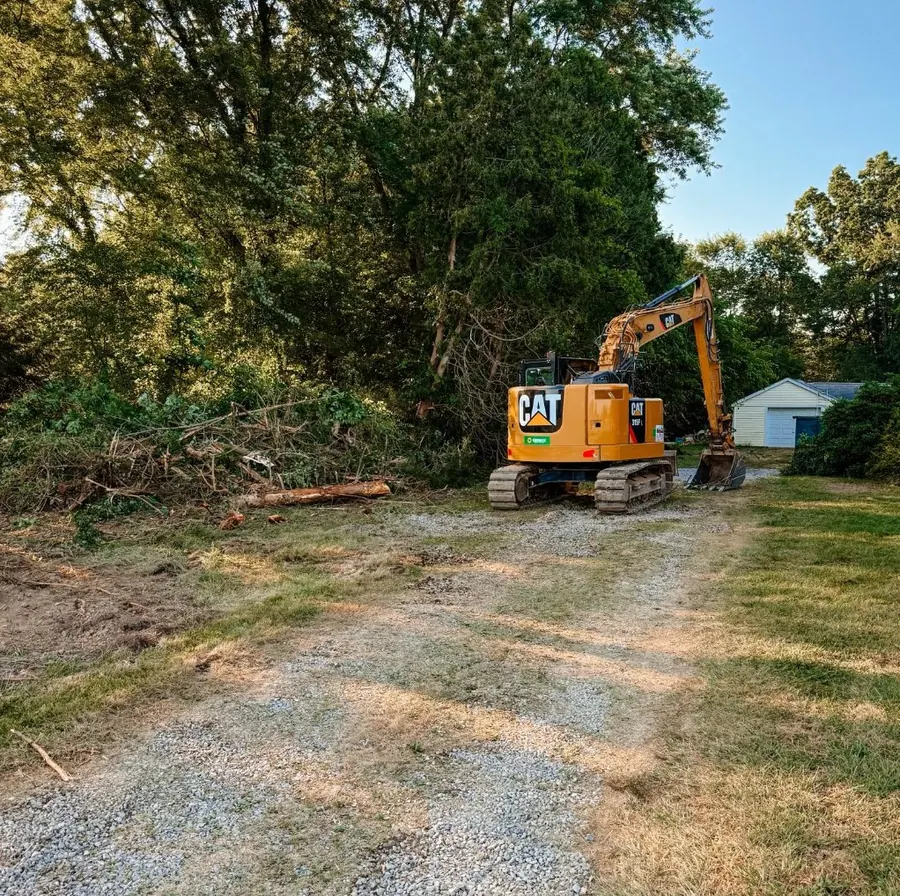
A gravel driveway lasts when it is built in layers on firm ground: strip the topsoil, lay fabric over soft clay, put down a base of large angular stone, cap it with a smaller crushed stone that packs tight, and shape a crown so water runs off both sides. Skip the base or the drainage and the stone sinks into the mud within a few seasons.
Lay it out for the trucks, not just the car
Start with the route. Follow the high ground where you can, because a drive through a low spot will always be wet. Keep curves wide enough for a delivery truck, a propane truck or a fire engine, and plan a place to turn around near the house. Decide the width by what will use it: a car, a pickup with a trailer, or farm equipment. Look at where the drive meets the road, too. You want a clear view both ways and a mouth wide enough to swing in without dropping a wheel in the ditch.
Strip the topsoil and anything that rots
Stone laid on sod is wasted. Grass, roots and dark topsoil are soft and full of organic matter. Under the weight of traffic they squeeze up into the stone and the stone sinks into them. So the first real step is to dig the driveway footprint down to firm subsoil and take the organic layer off. Stumps in the path come out completely. Low, soft places are dug out and filled with stone. The strip should be a little wider than the finished drive so the edges of the stone have something solid to sit on.
Fabric and a base of big stone
On the heavy clay common in northeastern Ohio, geotextile fabric is often laid on the subsoil before any stone. It keeps the clay and the stone from mixing, which is what turns a driveway to mud. On top of that goes the base: large, angular crushed stone that locks together and spreads the load of a vehicle over a wide area. How thick the base needs to be depends on how soft the ground is and how heavy the traffic will be. A lane for loaded trucks or farm equipment needs more than a short drive for two cars.
A top layer that packs
The surface layer is a smaller crushed stone that includes fines, the dust and small chips left from crushing. Ohio quarries sell mixes like this under names such as 304 and 411. The fines fill the gaps between the larger pieces, and when the layer is graded and packed it sets into a hard surface that sheds water. Round river gravel and pea gravel look nice in a bag but roll under tires and never lock up. Clean, washed stone with no fines drains well but stays loose. For the top of a driveway, you want angular stone with fines.
Crown it and give the water somewhere to go
Water is what ruins gravel driveways. A drive that is flat or dished holds puddles, and every tire that hits a puddle pumps out fines and starts a pothole. The cure is a crown: the middle of the drive sits a little higher than the edges, so rain runs off to both sides. On a hillside the whole surface can tilt one way instead. Then the water needs a path. Shallow ditches or swales along the edges carry it downhill, and the drive should sit slightly above the ground beside it, not in a trench.
The culvert at the road, and the permit
Where the driveway crosses the roadside ditch, a culvert pipe lets the ditch keep flowing underneath. It has to be large enough, set on a firm bed at the right slope, and covered with enough stone that vehicles do not crush it. This part of the job sits in the road right-of-way, so the road's owner has a say. The Trumbull County Engineer, for one, lists driveway access and driveway culverts under its right-of-way permit. Townships, cities, the state and, across the line, Pennsylvania each have their own process. Ask before you build.
The first year and the upkeep after
A new driveway settles. Traffic and weather pack the stone, and a soft spot or two may show up over the first winter. That is normal, and a light regrade with a top-dress of stone takes care of it. After that, upkeep is simple. Regrade when the crown flattens or the stone migrates to the edges. Fix potholes by cutting them out and regrading, not by dropping loose stone in the hole. Keep the ditches and the culvert open. See what we do on our gravel driveway installation and repair page.
Common Questions
How do you install gravel for a driveway over clay soil?
Strip the topsoil down to firm clay, lay geotextile fabric so the clay cannot pump up into the stone, and build a base of large angular stone before adding a packed top layer of crushed stone with fines. Shape a crown and side ditches so water leaves the surface fast. Clay holds water, so drainage matters even more than on sandy ground.
How deep should the stone be on a gravel driveway?
There is no one depth that suits every drive. Firm, dry subsoil carrying cars needs less stone than soft clay carrying loaded trucks. What matters is a base thick enough to spread the load and a top layer thick enough to pack and wear. Jeff looks at the ground and asks about the traffic you expect before he recommends the layers.
Do I need fabric under a gravel driveway in Ohio?
On firm, well-drained ground you can get by without it. On the wet clay found across much of northeastern Ohio, fabric is a small cost that earns its place, because it stops the stone from being pushed down into the mud and the mud from working up. If your yard stays soft in spring, plan on fabric.
What to Do Next
If you need a new drive or want an old one fixed properly, call Jeff at (330) 625-5754. He will look at the route, the soil and the drainage and give you a free estimate. See our guide to what a gravel driveway costs, or the driveway pages for Cortland and Warren.